


Stage 21 From Glacier to Wine South Route Eibiswald - Remschnigg
Accessible by public transport- Public bus (within 15 minutes walking distance from starting point)
Characteristics
SkillThe tour in numbers
Level of difficulty
medium
Route
20,8 km
Time
7:30 h
Uphill
834 hm
Downhill
572 hm
Highest point
905 m
This stage of the Hiking Trail From Glacier to Wine follows the Border Panorama Trail in its second half, a route that can be regarded as the backbone of the hiking trail network along the border between Steiermark and Slovenia. The trail also forms part of the International Long-Distance Trail from Sillian in East Tyrol to Bad Radkersburg in south-eastern Steiermark. Along its Styrian section, the route repeatedly crosses the border between Austria and Slovenia, leading hikers through a varied landscape of alpine pastures, rolling hills, vineyards, and traditional wine-growing villages within the South Steiermark Nature Park. One of the most beautiful viewpoints of the stage awaits at the Remschnigg Alm, not far from the day's destination. From here, sweeping panoramas open up across both Steiermark and Slovenia, offering a fitting introduction to the landscapes that characterise the southernmost part of the Hiking Trail From Glacier to Wine.
Stretching for more than 12,500 kilometres, the European Green Belt forms a unique ecological corridor along the route of the former Iron Curtain, extending from the far north of Europe to its southernmost regions.
For decades, this border separated Steiermark and Slovenia, although unlike many other sections of the Iron Curtain, there was never a continuous border fence here. Nevertheless, the border remained a significant obstacle for people. For nature, however, it became a largely undisturbed strip of land, spared from intensive human use for many years.
As a result, valuable habitats were able to develop and survive along this corridor. Today, ancient forests, rivers, wetlands, and species-rich cultural landscapes are linked together like pearls on a necklace. Among them is the South Steiermark Nature Park, whose vineyards, orchards, woodlands, and meadows contribute to the exceptional biodiversity that characterises the Green Belt.
What was once a symbol of division has become one of Europe's most remarkable transboundary nature conservation projects.
Best season
January
February
March
April
May
June
July
August
September
October
November
December
More information
At the beginning of this stage of the Hiking Trail From Glacier to Wine, we leave the charming market town of Eibiswald, with its elegant 18th- and 19th-century town houses, and head south towards the Kohlweiß Chapel. Here, we keep left and follow Trail 592 on the ascent to St. Pongratzen.
Along the way, we reach the Church of St. Pongratzen, which stands at an altitude of 900 metres above sea level entirely on Slovenian territory and is administered by the Archdiocese of Maribor. The church was first mentioned in historical records in 1490, while the present Baroque building dates from 1655. Owing to its location directly on the border, the church tower served as a lookout point during the interwar years. Following the Second World War, the church fell into neglect, and only a major restoration in 1966 saved it from complete decay. Today, its bell tower rewards visitors with magnificent views across both Steiermark and Slovenia.
Continuing along the Styrian-Slovenian border, we venture deeper into the southern Styrian wine country. The route involves only modest changes in elevation and leads mainly through peaceful forests, interspersed with clearings that offer beautiful views across the vineyards and rolling landscapes of the South Steiermark Nature Park.
Our next stop is the panoramic tavern of the Tertinek family (vlg. Mukonig) (Tel. +43 3455 6145), located at the southern entrance to the Altenbach Gorge, a true natural gem. One of the highlights of a walk through the gorge – especially for younger visitors – is the 30-metre suspension bridge, which crosses the gorge at a height of around six metres above the stream below.
Back on the main route, the trail continues along forest tracks and quiet gravel roads past the estates of Tschermonegg on the Slovenian side and Wechtitsch. Soon we reach a former Yugoslav border outpost (Karaula), now abandoned but still a reminder of the region's recent history.
Beyond an old border hut, the route climbs gently through woodland before emerging onto a clearing with magnificent views across the surrounding wine country. After a few more minutes, a beech forest leads us to the ascent of the Remschnigg Alm, the southernmost alpine pasture in Austria. Here, the Poglei Hut (Tel. +43 664 2710820) provides a welcome opportunity for refreshments while offering sweeping views across the border region.
For those staying overnight, several accommodation options are located near the alpine pasture, including the Scherschenhof (1.5 km), the Pronegg Holiday Apartment (2.2 km), the Sternat-Lenz Guesthouse (3.2 km), and the Poscharnik Guesthouse (3.6 km).
The following stage continues through the heart of the South Styrian wine country towards Leutschach.
Emergency call mountain rescue: 140
Tips when reporting an emergency – Answer these six WH questions: What happened? How many people are injured? Where did the accident happen (are there GPS coordinates)? Who is reporting the incident (callback number)? When did the accident happen? What is the weather like at the site of the incident?
Proper backpack packing makes many things easier: Pack heavy things first. The water bottle should always be within reach in a side pocket. All the things that are often needed, such as sunglasses, camera or hiking map, belong on top. An emergency kit, including blister plasters, belongs in every rucksack and it is always advisable to dress in layers.
In the Thermen- & Vulkanland region of Styria, Eastern Styria and Southern and Western Styria, the GenussCard opens the door to over 200 excursion destinations when you stay overnight in one of the approximately 100 GenussCard partner establishments. Countless of these GenussCard excursion destinations, ranging from culinary manufactories to bathing lakes and museums, are located directly on the hiking route "From Glacier to Wine".
Accessible by
train and bus: detailed information about arriving by ÖBB (Austrian Federal
Railways) can be found at www.oebb.at or
on the Verbundlinie Steiermark website www.busbahnbim.at
With
Verbundlinie’s BusBahnBim route planner app, planning your journey
has never been easier: simply enter towns and/or addresses, stop names or
points of interest to check all bus, train and tram connections in Austria. The
app is available free of charge for smartphones – on Google Play and in the App
Store
Steiermark Tourismus, Tel. +43 316 4003
www.steiermark.com
Kompass WK224 Steirisches Weinland- Stainz, Sausal, Sulmtal, Leibnitz www.kompass.at
Freytag & Berndt WK411 Steirisches Weinland · Südwest Steiermark www.freytagberndt.at
Map & downloads
Gallery
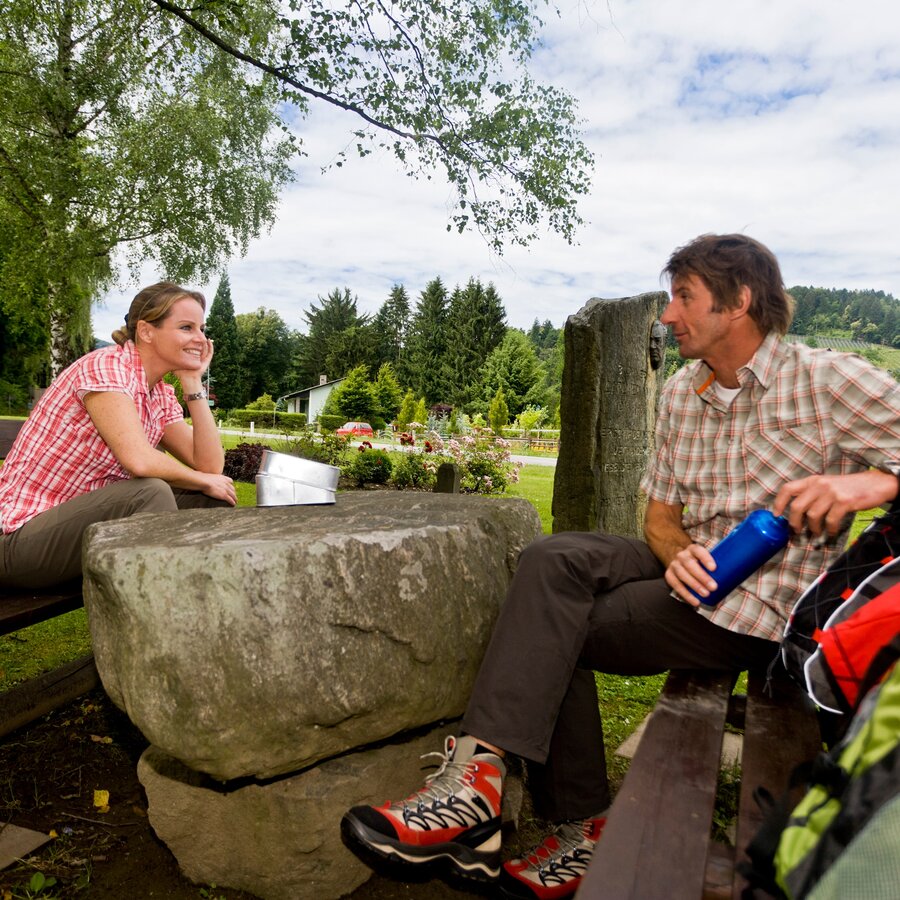
Stärkung in Eibiswald vor dem Start | © Steiermark Tourismus | Leo Himsl
1/7
Wanderroute "Vom Gletscher zum Wein" | Weitwanderweg Steiermark | © Steiermark - Das Grüne Herz
2/7
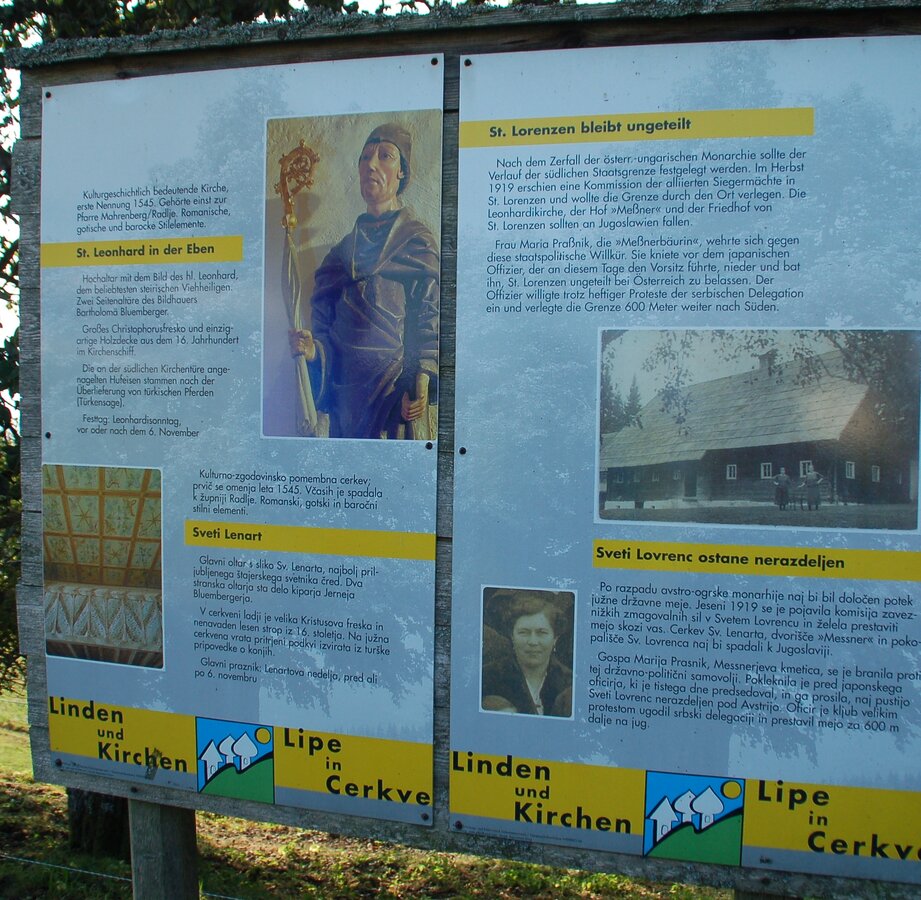
Erinnerungstafel an die Grenzziehung zwischen Slowenien und Österreich im Jahr 1918 | © Steiermark Tourismus | Günther Steininger
3/7
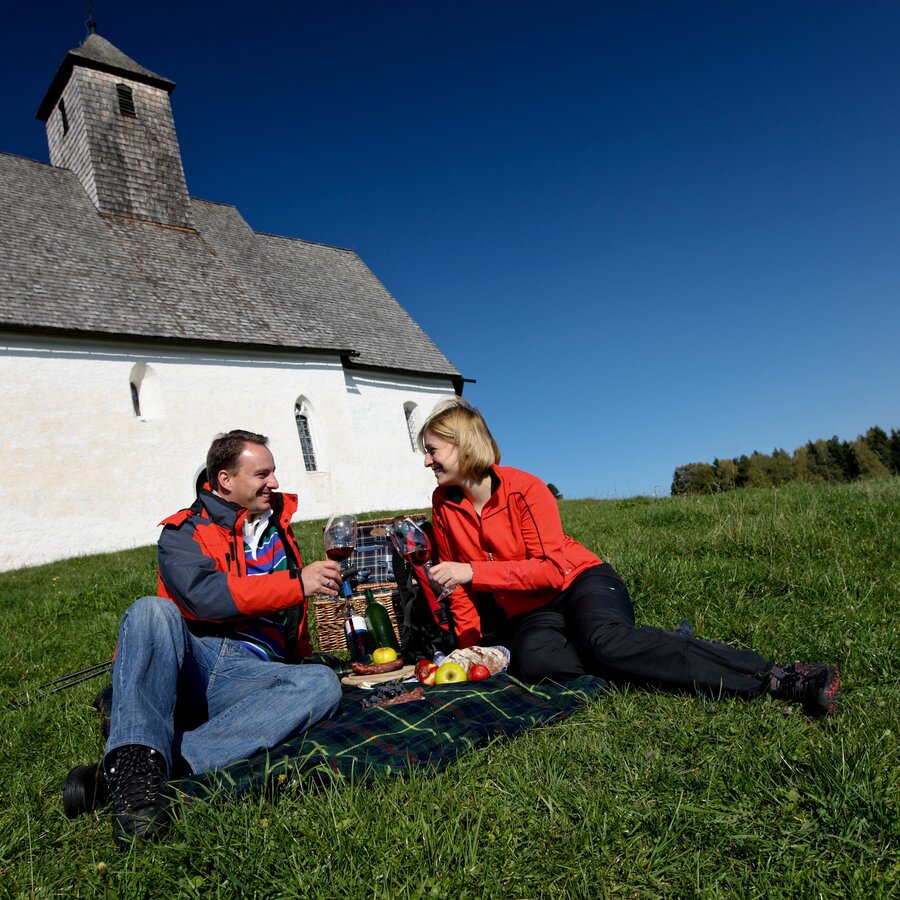
Rast an der österreichisch-slowenischen Grenze | © Steiermark Tourismus | Harry Schiffer
4/7
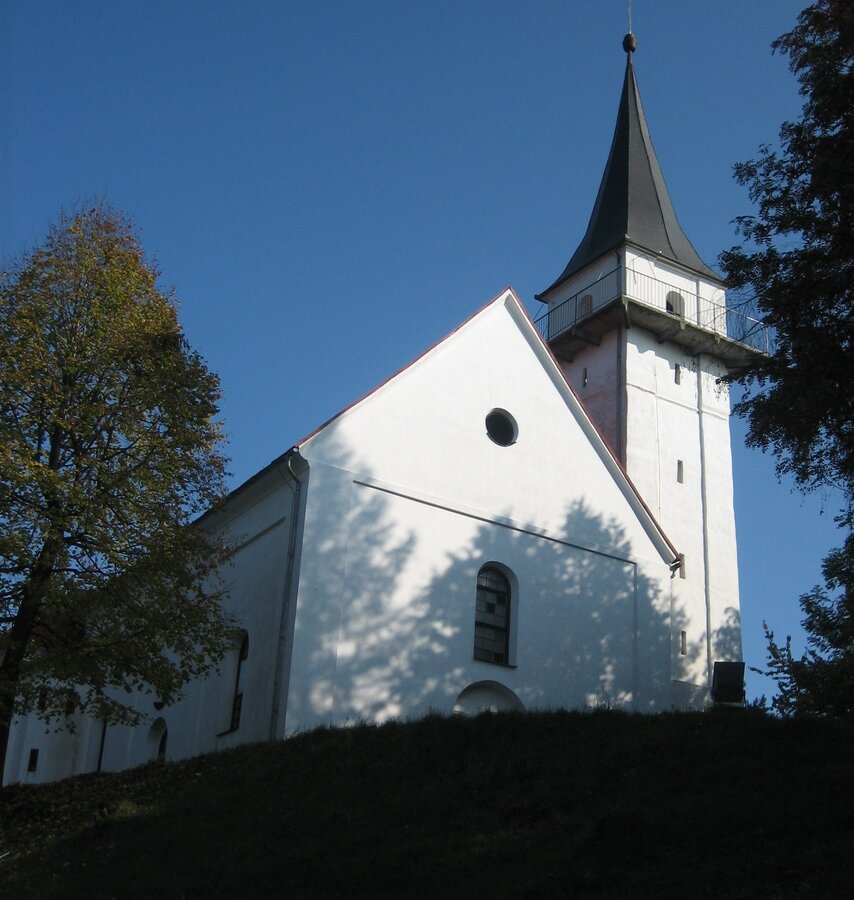
Aussichtsturm St. Pongratzen - Großradl | © Südsteiermark
5/7
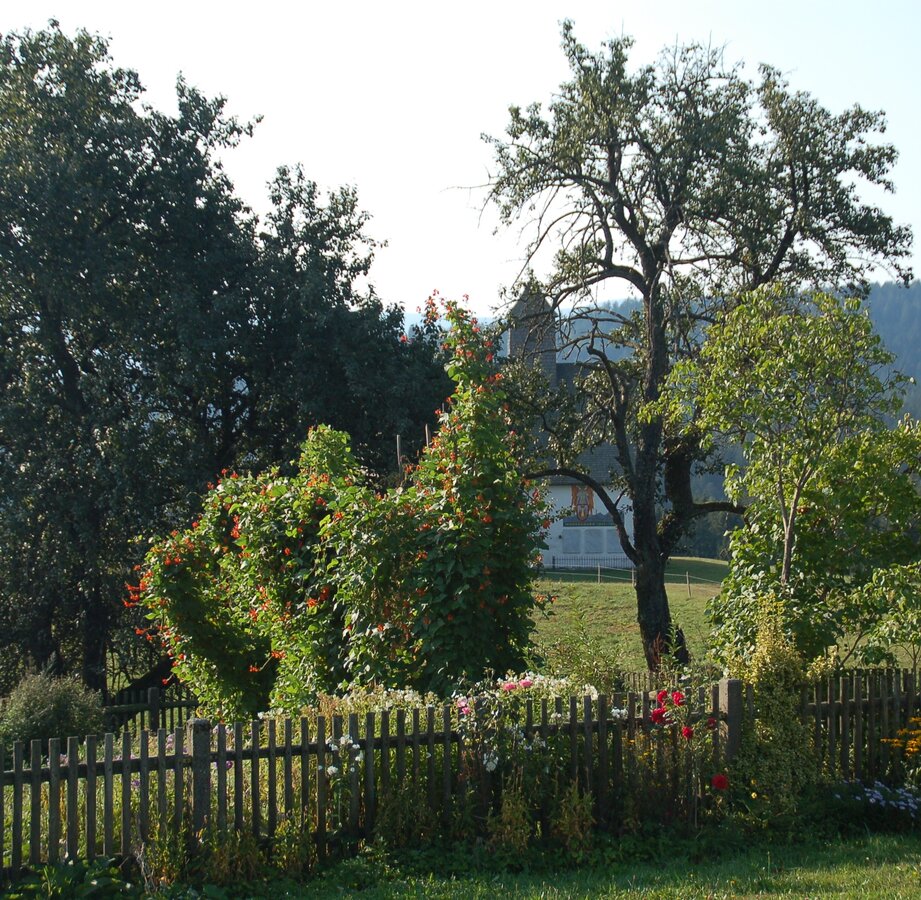
Kleiner Bauerngarten bei St. Lorenzen direkt an der Grenze zu Slowenien | © Steiermark Tourismus | Günther Steininger
6/7
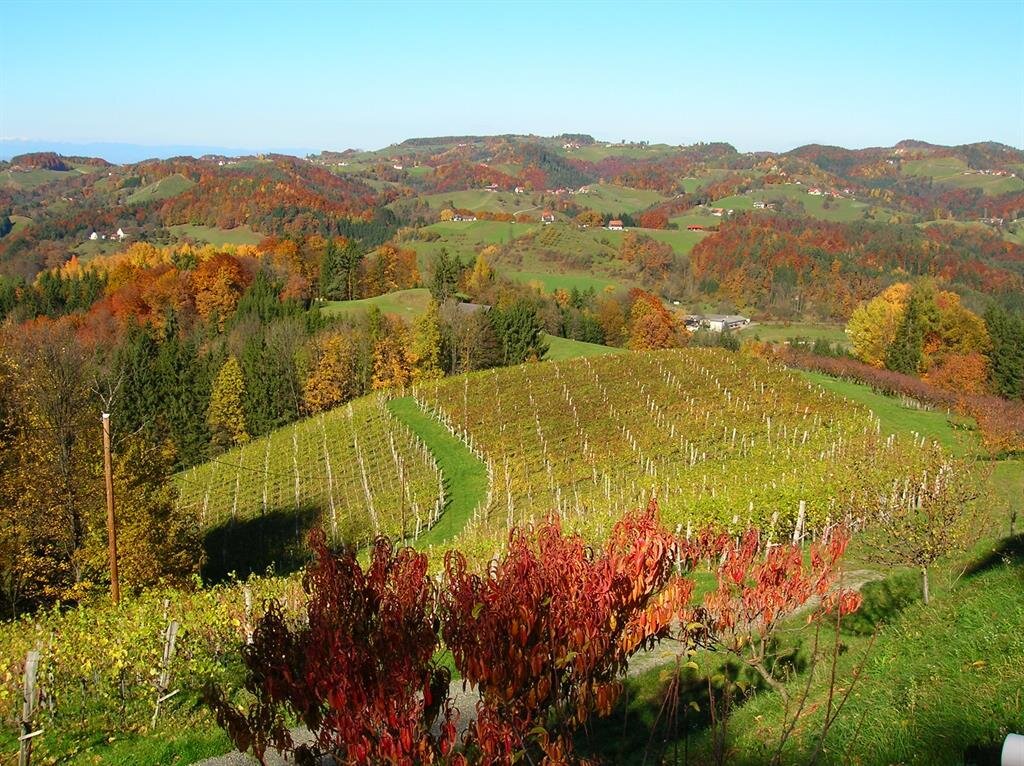
Weingut Sternat Lenz Weingarten | © Unbekannt
7/7

What the weather will be like Eibiswald (382m)
Today, 22.10.2026
The rain will end in the early afternoon, and the skies will clear afterwards.Morning

9°C
sr.Regenwahrscheinlichkeit
95%
sr.Windstärke
5 km/h
Noon
14°C
sr.Regenwahrscheinlichkeit
75%
sr.Windstärke
5 km/h
Night

8°C
sr.Regenwahrscheinlichkeit
10%
sr.Windstärke
0 km/h
Tomorrow, 23.10.2026
The day starts sunny, but will be partly cloudy in the afternoon.Morning
2°C
sr.Regenwahrscheinlichkeit
0%
sr.Windstärke
0 km/h
Noon

12°C
sr.Regenwahrscheinlichkeit
0%
sr.Windstärke
5 km/h
Night

7°C
sr.Regenwahrscheinlichkeit
0%
sr.Windstärke
0 km/h
Forecast
24.10.2026
2°C
11°C
25.10.2026
1°C
11°C
26.10.2026
3°C
15°C
