


Stage 32 From Glacier to Wine North Route Riegersburg - Fehring
Accessible by public transport- Public bus (within 15 minutes walking distance from starting point)
Characteristics
SkillThe tour in numbers
Level of difficulty
easy
Route
12,9 km
Time
4:00 h
Uphill
143 hm
Downhill
237 hm
Highest point
384 m
This stage of the Hiking Trail From Glacier to Wine follows the East Austrian Borderland Trail 07 from Riegersburg southwards into the Raab Valley, where the small town of Fehring awaits. Leading through forests, across meadows, and past orchards, the route is one of the gentler stages of the journey. Both the distance and the elevation gain are moderate, while the charming landscape and the frequent stretches of shady woodland make for particularly enjoyable walking, especially during the warmer months. Thanks to the relatively short length of the stage, there is ample opportunity to begin the day with a visit to Riegersburg Castle. Perched atop a dramatic volcanic basalt rock, the fortress is one of the most iconic landmarks in southeastern Steiermark. Countless legends, tales of adventure, and stories from centuries past surround the castle, adding to its unique atmosphere. Throughout its long history, the fortress remained unconquered despite numerous attempts. Today, the mighty basalt cone on which it stands is framed by vineyards, creating one of the most distinctive cultural landscapes in the region. After leaving Riegersburg behind, the route continues through the gently rolling countryside of the Thermen- & Vulkanland region before reaching Fehring, a welcoming small town in the heart of the Raab Valley and the destination of the day’s stage.
Numerous small wine-growing enclaves shape the landscape of Vulkanland Steiermark, where vineyards flourish on the slopes of extinct volcanoes and lend the region its distinctive character.
Around 1,400 hectares of vineyards are cultivated here, concentrated primarily around Klöch, St. Anna am Aigen, and Straden. Among the many grape varieties grown in the region, one stands out in particular: the highly aromatic Traminer, which has become a hallmark of southeastern Steiermark and enjoys an excellent international reputation.
For centuries, this corner of Steiermark formed a strategically important border region and was frequently the scene of military conflicts. Numerous castles and fortified residences, often perched dramatically on basalt outcrops, still bear witness to this eventful past. Today, however, borders are open and these historic landmarks have taken on new roles. Castles such as Riegersburg Castle and Kapfenstein Castle now serve as venues for cultural events, concerts, wine experiences, and culinary celebrations.
The region's wine culture can also be experienced through a wide range of traditional events and festivals. Highlights include the Kellerstöckl Hoamsuachn, the popular Open Cellar Door Days, and the Südoststeirische Thermenland Wine Days, all of which offer visitors the opportunity to discover the wines, producers, and traditions of the region in a particularly authentic way.
Together, the volcanic soils, centuries-old wine-growing traditions, and vibrant event culture make the wine region around Fehring one of the most distinctive and enjoyable destinations in southeastern Steiermark.
Best season
January
February
March
April
May
June
July
August
September
October
November
December
More information
Detaillierte Informationen zur Anreise finden Sie hier.
Around the center of Riegersburg there are several parking facilities available, such as at the lakeside resort.
After hiking from east to west on the previous stage from Unterlamm to Riegersburg, we now turn south once again, following the overall direction of the Hiking Trail From Glacier to Wine towards its destination in the wine country of southern Steiermark. On this stage, we follow the Styrian section of the East Austrian Borderland Trail 07, which stretches from Nebelstein in the north to Bad Radkersburg in the south.
Leaving Riegersburg, the trail initially passes the bathing lake and follows a quiet road towards the southeast. Soon, however, it branches off to the right and climbs gently past beautifully situated farmsteads, family homes, and vineyards towards the Buchberg. While some sections follow local access roads, the route repeatedly rewards hikers with pleasant forest and field paths. Especially during the warmer months, the shaded woodland sections are a welcome companion along the way.
Although the stage itself is relatively gentle, the landscape continues to lead us from one “mountain” to the next. From the Forchauberg, the route turns southeast and continues over the Stückelberg and Faschingberg towards Rattenberg. At a crossroads, we turn right and begin a gradual descent through the cultivated landscape of the Thermen- & Vulkanland region. The numerous roads and farm tracks criss-crossing the countryside can occasionally make orientation challenging, but the beautifully situated Kapper Winery provides a clear landmark.
The climb to the winery is rewarded with magnificent views across the Raab Valley, which forms the setting for the final section of today's stage and also accompanies the beginning of the next stage towards Kapfenstein. A nearby viewpoint offers another excellent opportunity to take in the rolling hills, vineyards, and villages that characterise this distinctive landscape.
The Raab River, around 250 kilometres long, rises south of the Teichalm in the Almenland Nature Park and eventually flows into a tributary of the Danube near Győr in Hungary. Following the valley floor, the trail gradually approaches Fehring. Before reaching the town centre, we pass the railway station on the line connecting Graz with Hungary and soon arrive at the historic Berghofer Mill. First documented in the 12th century, the mill is today one of the region’s best-known mills and is operated by the three Berghofer sisters in the sixth generation.
The stage concludes in Fehring, a municipality of around 7,500 inhabitants comprising 17 villages, located in the geographical centre of the thermal spa region with its six renowned thermal resorts. One of these, Bad Gleichenberg, will be the destination of the next stage.
Fehring offers visitors the opportunity to discover the culinary richness of Eastern Steiermark and the Thermen- & Vulkanland region. Products from alpine pastures, orchards, vegetable gardens, and herb gardens are transformed into exceptional dishes by creative chefs and skilled producers. Fine wines, premium fruit spirits, refreshing fruit juices, traditional ciders, and regional beers all contribute to a culinary culture that perfectly reflects the character of this fertile and diverse landscape.
Emergency call mountain rescue: 140
Tips when reporting an emergency – Answer these six WH questions: What happened? How many people are injured? Where did the accident happen (are there GPS coordinates)? Who is reporting the incident (callback number)? When did the accident happen? What is the weather like at the site of the incident?
Proper backpack packing makes many things easier: Pack heavy things first. The water bottle should always be within reach in a side pocket. All the things that are often needed, such as sunglasses, camera or hiking map, belong on top. An emergency kit, including blister plasters, belongs in every rucksack and it is always advisable to dress in layers.
In the Thermen- & Vulkanland region of Styria, Eastern Styria and Southern and Western Styria, the GenussCard opens the door to over 200 excursion destinations when you stay overnight in one of the approximately 100 GenussCard partner establishments. Countless of these GenussCard excursion destinations, ranging from culinary manufactories to bathing lakes and museums, are located directly on the hiking route "From Glacier to Wine".
Accessible by train and bus.
Detailed information about arriving by ÖBB (Austrian Federal Railways) can be found at www.oebb.at or on the Verbundlinie Steiermark website www.busbahnbim.at
With Verbundlinie’s BusBahnBim route planner app, planning your journey has never been easier: simply enter towns and/or addresses, stop names or points of interest to check all bus, train and tram connections in Austria. The app is available free of charge for smartphones – on Google Play and in the App Store
Steiermark Tourismus, Tel. +43 316 4003
www.steiermark.com
Kompass WK225 Steirisches Hügel-, Vulkan- und Thermenland, Mureck, Bad Radkersburg, Murska Sobota www.kompass.at
Freytag & Berndt WK423 Steirisches Thermenland · Südliches Burgenland · Steirisches Vulkanland www.freytagberndt.at
Rother Wanderführer "Vom Gletscher zum Wein": auf 160 Seiten mit 80 Farbabbildungen 60 Höhenprofile, 60 Wanderkärtchen im Maßstab 1:75.000, zwei Übersichtskarten, GPS-Tracks zum Download, Format 11,5 x 16,5 cm, kartoniert mit Polytex-Laminierung, ISBN 978-3-7633-4550-2, www.rother.de
Map & downloads
Gallery
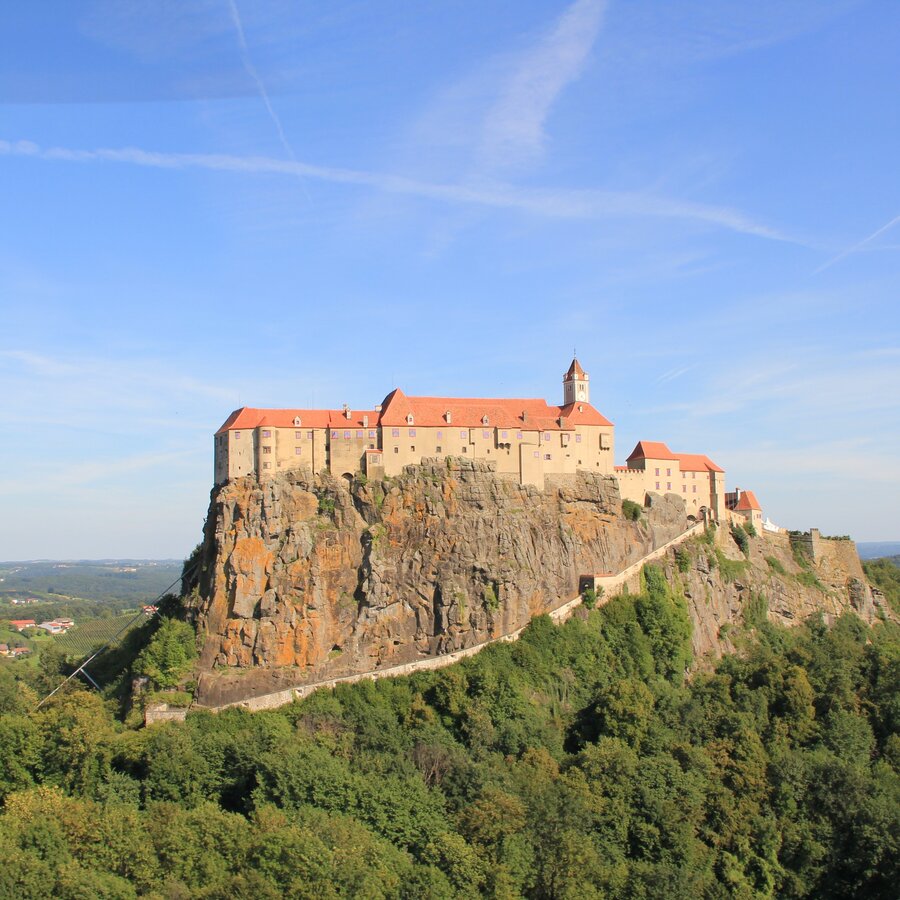
Riegersburg Castle | © Burg Riegersburg
1/3
Wanderroute "Vom Gletscher zum Wein" | Weitwanderweg Steiermark | © Steiermark - Das Grüne Herz
2/3
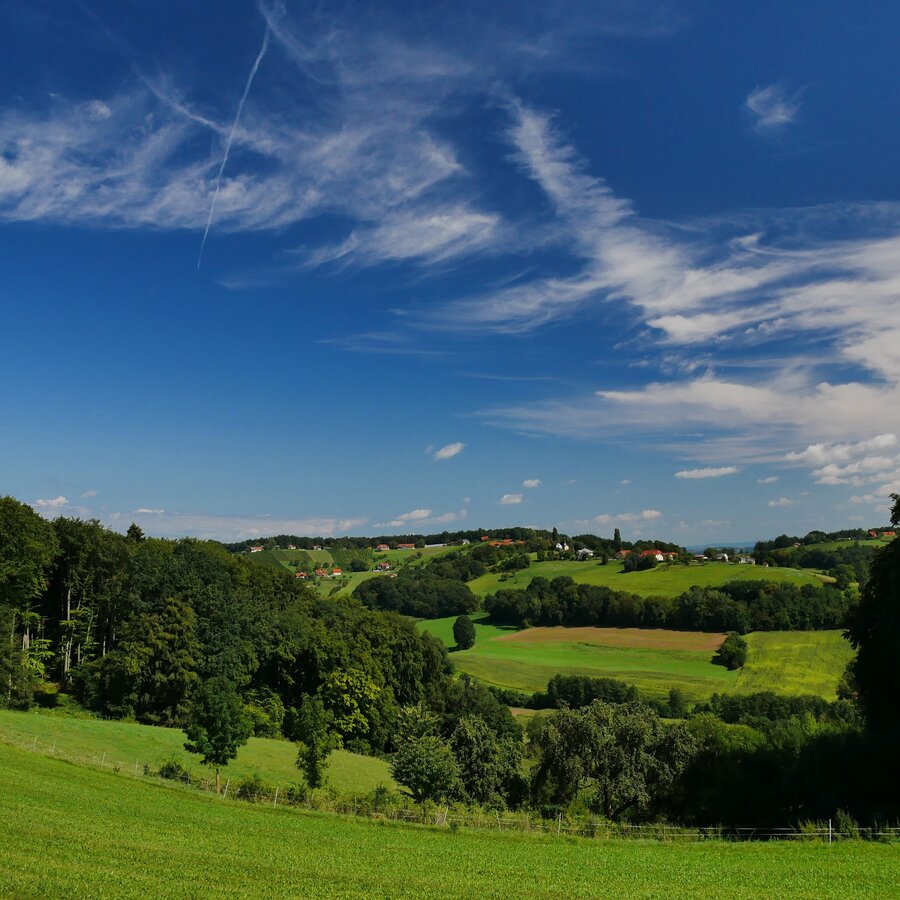
Ausblicke im Thermen- und Vulkanland | © Steiermark Tourismus | Manfred Polansky
3/3

What the weather will be like Riegersburg (372m)
Today, 14.10.2026
Morning clouds will clear gradually. Then frequent sunny periods.Morning

5°C
sr.Regenwahrscheinlichkeit
25%
sr.Windstärke
0 km/h
Noon
16°C
sr.Regenwahrscheinlichkeit
15%
sr.Windstärke
5 km/h
Night

10°C
sr.Regenwahrscheinlichkeit
0%
sr.Windstärke
0 km/h
Tomorrow, 15.10.2026
Dry and partly sunny throughout the day, with cloudy periods from time to time.Morning
6°C
sr.Regenwahrscheinlichkeit
0%
sr.Windstärke
0 km/h
Noon
16°C
sr.Regenwahrscheinlichkeit
0%
sr.Windstärke
5 km/h
Night
11°C
sr.Regenwahrscheinlichkeit
0%
sr.Windstärke
0 km/h
Forecast
16.10.2026

5°C
17°C
17.10.2026
4°C
17°C
18.10.2026

6°C
16°C
