


Stage 20 From Glacier to Wine South Route Bad Schwanberg - Eibiswald
Accessible by public transport- Train (within 15 minutes walking distance from starting point)
- Public bus (within 15 minutes walking distance from starting point)
Characteristics
SkillThe tour in numbers
Level of difficulty
easy
Route
11,9 km
Time
4:00 h
Uphill
332 hm
Downhill
368 hm
Highest point
602 m
A scenic stage of the Hiking Trail From Glacier to Wine through the heart of the Schilcherland. The destination is Eibiswald, one of Austria's most important centres for long-distance hiking. No fewer than three major long-distance trails of the Austrian Alpine Club converge here: the Mariazell Trail 06, the Southern Alpine Trail 03, and the North–South Trail 05. Eibiswald is also located on the route of the European Long-Distance Trail E6, which stretches across Europe from the Baltic Sea to the Aegean Sea. As a result, the town has developed into a true meeting point for hikers exploring some of the continent's most diverse landscapes and cultures. With its strong hiking tradition and strategic location at the crossroads of several renowned routes, Eibiswald is rightly regarded as one of Austria's premier long-distance hiking destinations.
Eibiswald is also home to the Austrian Alpine Club Long-Distance Hiking Museum, a unique institution run with great dedication and enthusiasm for the history of long-distance hiking.
The museum is housed in the historic Lerchhaus, located on the Upper Square of Eibiswald. Parts of the building date back to the 16th century, while the museum itself has occupied the courtyard wing since 1998.
Based on the extensive Hermann Collection, the exhibition explores the origins and development of long-distance hiking, while also highlighting the strong regional connection to this important aspect of Alpine culture.
The museum is closely linked to the life and work of Carl Hermann, who was born on 28 October 1918 in Wolfgruben, near Wies and Eibiswald. An Austrian sculptor, cultural advocate, author, and passionate hiker, he is best known as the founder of the North–South Trail 05, one of Austria's most important long-distance hiking routes.
Best season
January
February
March
April
May
June
July
August
September
October
November
December
More information
Detailed information on how to get to Bad Schwanberg can be found here.
There are numerous parking spaces available in Bad Schwanberg.
From Bad Schwanberg, this stage of the Hiking Trail From Glacier to Wine begins with an ascent to Limberg Castle, beautifully situated in the middle of a forest and today used as a youth and holiday camp.
The castle was first mentioned in historical records in 1244 under the name Lindenperch. The present structure largely dates from the 16th and 17th centuries. On the valley side stands an outer bailey with a central gate tower and two corner towers, connected to the main building by arcaded galleries. The outer bailey and the castle itself were once linked by defensive walls, with a moat and bridge separating the two sections. Today, visitors enter through the forecourt into a square-shaped castle complex with a rectangular inner courtyard surrounded by arcades. Among the historic interiors that have survived are the Knight's Hall, the Painted Room, and a ceremonial hall in the southern wing.
Returning to the route, the trail continues gently uphill through attractive woodland to the highest point of the stage at 608 metres above sea level. Shortly afterwards, we reach the Gasthaus Hochmasser (Tel. +43 3465 2105), an official stamp checkpoint for pilgrims travelling the Mariazell Trail.
Refreshed, we continue on a pleasant route that gradually descends towards the vineyards surrounding the settlement of Oberkraß, where traditional Buschenschänken, such as that of the Fürpaß family, invite hikers to stop and enjoy regional specialities. From Oberkraß, the route continues to Unterkraß, where we keep right towards Vordersdorf.
From here, the trail climbs gently once more over a small wooded hill before descending through a landscape of vineyards, farmhouses, and rural homes directly into Eibiswald.
With its Austrian Alpine Club Long-Distance Hiking Museum, historic town houses, and the Lerchhaus, which also serves as a small cultural centre, Eibiswald provides a fitting conclusion to a beautiful stage. The following day, the route continues into the South Steiermark Nature Park, where a new landscape and new experiences await.
Emergency call mountain rescue: 140
Tips when reporting an emergency – Answer these six WH questions: What happened? How many people are injured? Where did the accident happen (are there GPS coordinates)? Who is reporting the incident (callback number)? When did the accident happen? What is the weather like at the site of the incident?
Proper backpack packing makes many things easier: Pack heavy things first. The water bottle should always be within reach in a side pocket. All the things that are often needed, such as sunglasses, camera or hiking map, belong on top. An emergency kit, including blister plasters, belongs in every rucksack and it is always advisable to dress in layers.
In the Thermen- & Vulkanland region of Styria, Eastern Styria and Southern and Western Styria, the GenussCard opens the door to over 200 excursion destinations when you stay overnight in one of the approximately 100 GenussCard partner establishments. Countless of these GenussCard excursion destinations, ranging from culinary manufactories to bathing lakes and museums, are located directly on the hiking route "From Glacier to Wine".
Accessible by
train and bus: detailed information about arriving by ÖBB (Austrian Federal
Railways) can be found at www.oebb.at or
on the Verbundlinie Steiermark website www.busbahnbim.at
With
Verbundlinie’s BusBahnBim route planner app, planning your journey
has never been easier: simply enter towns and/or addresses, stop names or
points of interest to check all bus, train and tram connections in Austria. The
app is available free of charge for smartphones – on Google Play and in the App
Store
Steiermark Tourismus, Tel. +43 316 4003
www.steiermark.com
Kompass WK224 Steirisches Weinland- Stainz, Sausal, Sulmtal, Leibnitz www.kompass.at
Freytag & Berndt WK411 Steirisches Weinland · Südwest Steiermark www.freytagberndt.at
Map & downloads
Gallery
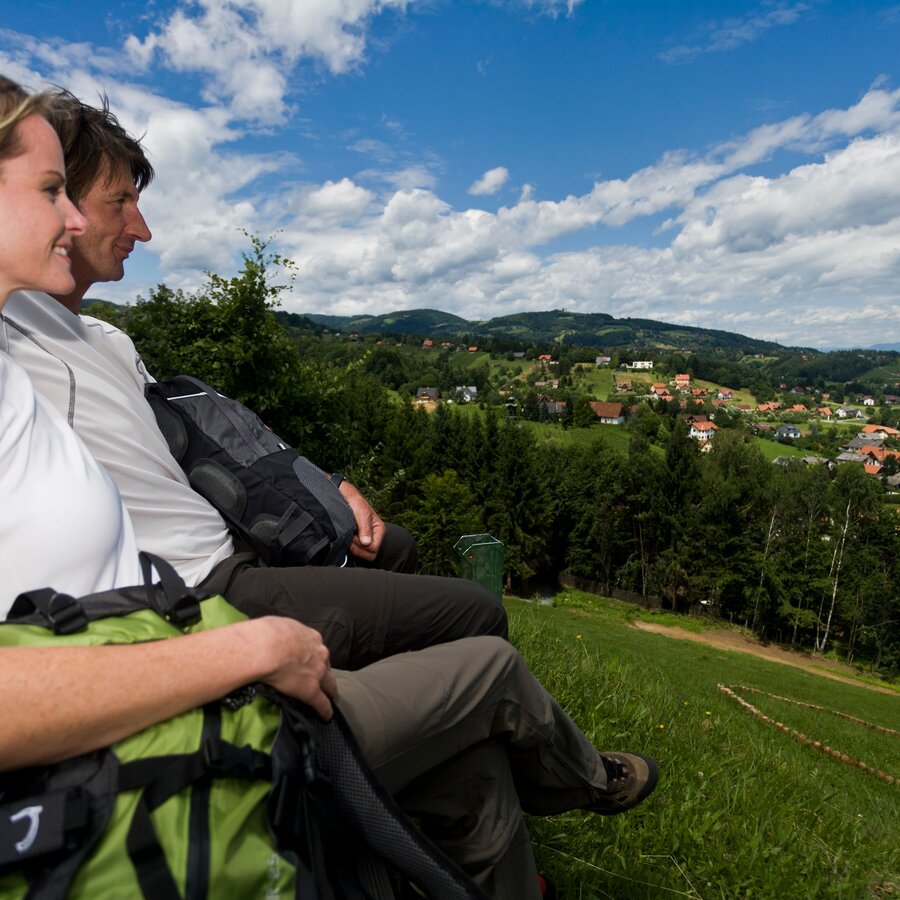
Blick auf Eibiswald | © Steiermark Tourismus | Leo Himsl
1/6
Wanderroute "Vom Gletscher zum Wein" | Weitwanderweg Steiermark | © Steiermark - Das Grüne Herz
2/6
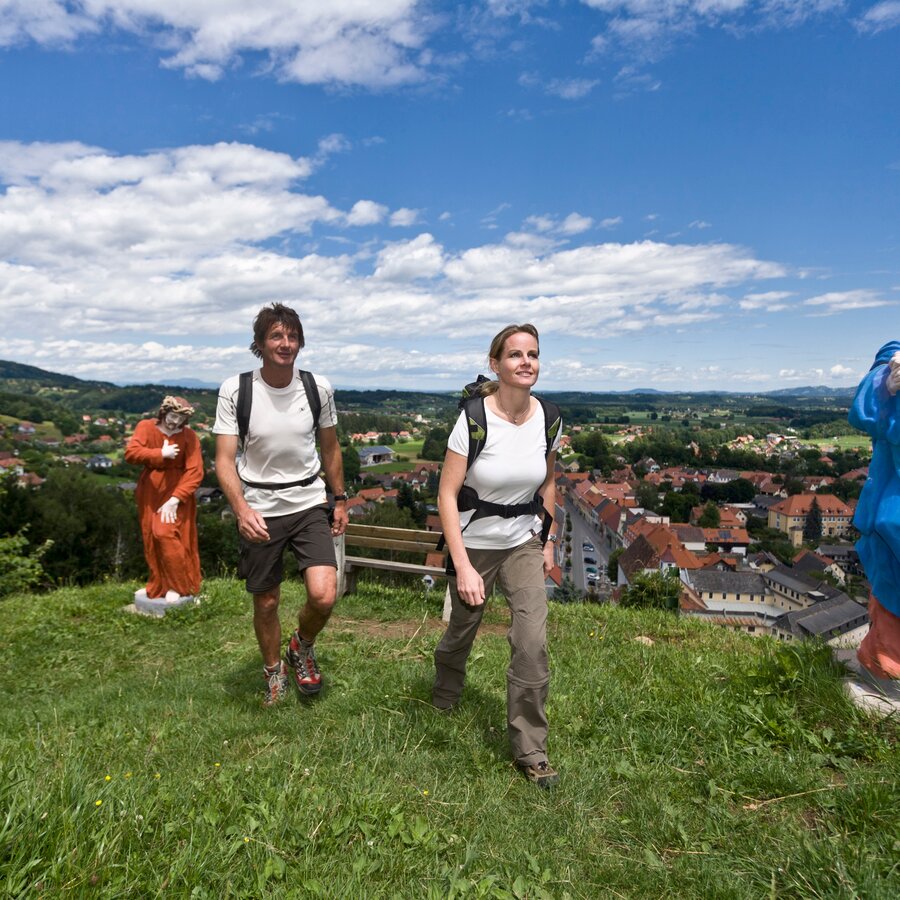
Am Josefiberg bei Schwanberg | © Steiermark Tourismus | Leo Himsl
3/6
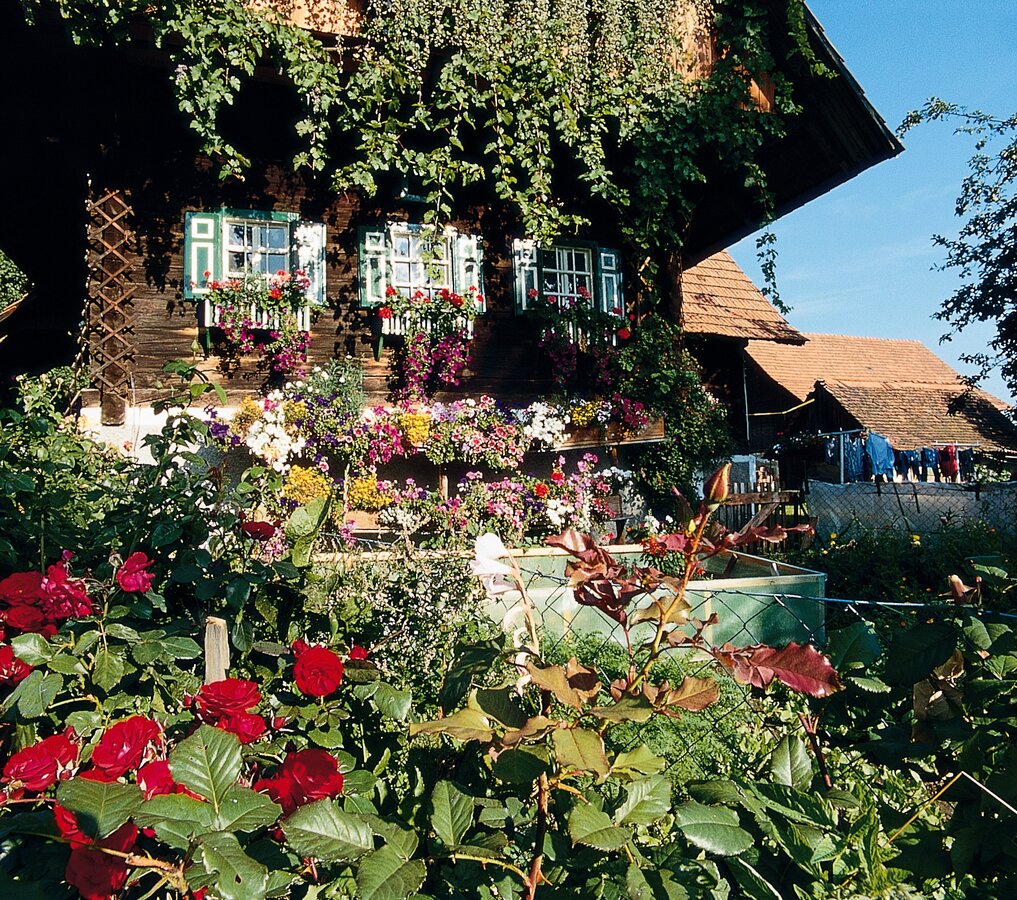
Ein typisch weststeirisches Bauernhaus | © Steiermark Tourismus | Reinhard Lamm
4/6
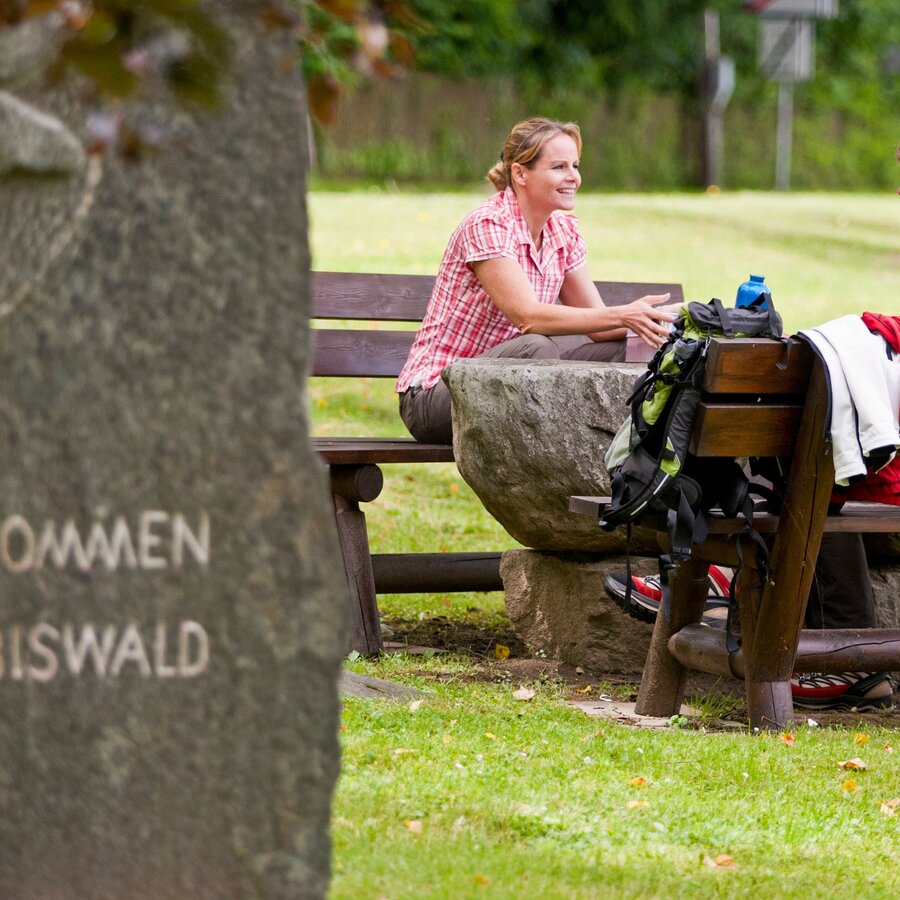
Angekommen in Eibiswald | © Steiermark Tourismus | Leo Himsl
5/6
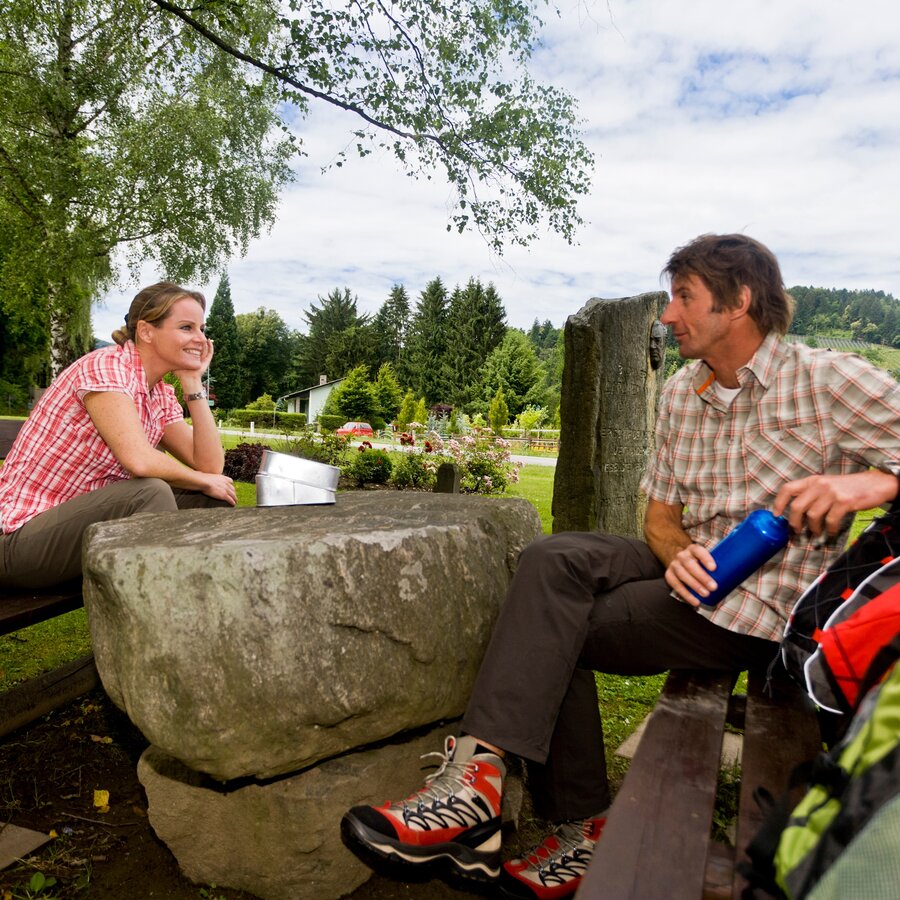
Stärkung in Eibiswald vor dem Start | © Steiermark Tourismus | Leo Himsl
6/6

What the weather will be like Schwanberg (418m)
Today, 09.10.2026
Scattered showers in the beginning, gradually becoming sunny in the afternoon.Morning

11°C
sr.Regenwahrscheinlichkeit
95%
sr.Windstärke
0 km/h
Noon

15°C
sr.Regenwahrscheinlichkeit
35%
sr.Windstärke
5 km/h
Night

11°C
sr.Regenwahrscheinlichkeit
15%
sr.Windstärke
0 km/h
Tomorrow, 10.10.2026
Partly sunny in the morning, gradually becoming cloudy in the afternoon.Morning

8°C
sr.Regenwahrscheinlichkeit
5%
sr.Windstärke
0 km/h
Noon
16°C
sr.Regenwahrscheinlichkeit
25%
sr.Windstärke
5 km/h
Night
12°C
sr.Regenwahrscheinlichkeit
45%
sr.Windstärke
0 km/h
Forecast
11.10.2026
9°C
17°C
12.10.2026
6°C
16°C
13.10.2026

4°C
17°C
