


Gesäuse National Park
Wild water. Steep cliffs.
Steep, wild, unique - the Gesäuse not only trumps with breathtaking views and raging streams, but also flora and fauna offer uniqueness in many respects. Like the spikes of a crown, the peaks of the Hochtor chain tower above this wonder of nature, the Gesäuse. There are around 200 endemics here, plants and insects that exist exclusively in this microcosm. A wonder of nature that should be marveled at and protected in equal measure, in October 2002 the Gesäuse was declared a national park.
Nature conservation is a top priority throughout the national park – yet you can still explore the stunning landscape at your own pace along marked trails. Whether you’re hiking, climbing, cycling or rafting, nature takes centre stage here. And you’re a most welcome guest!
Discover the National Park
National park Gesäuse
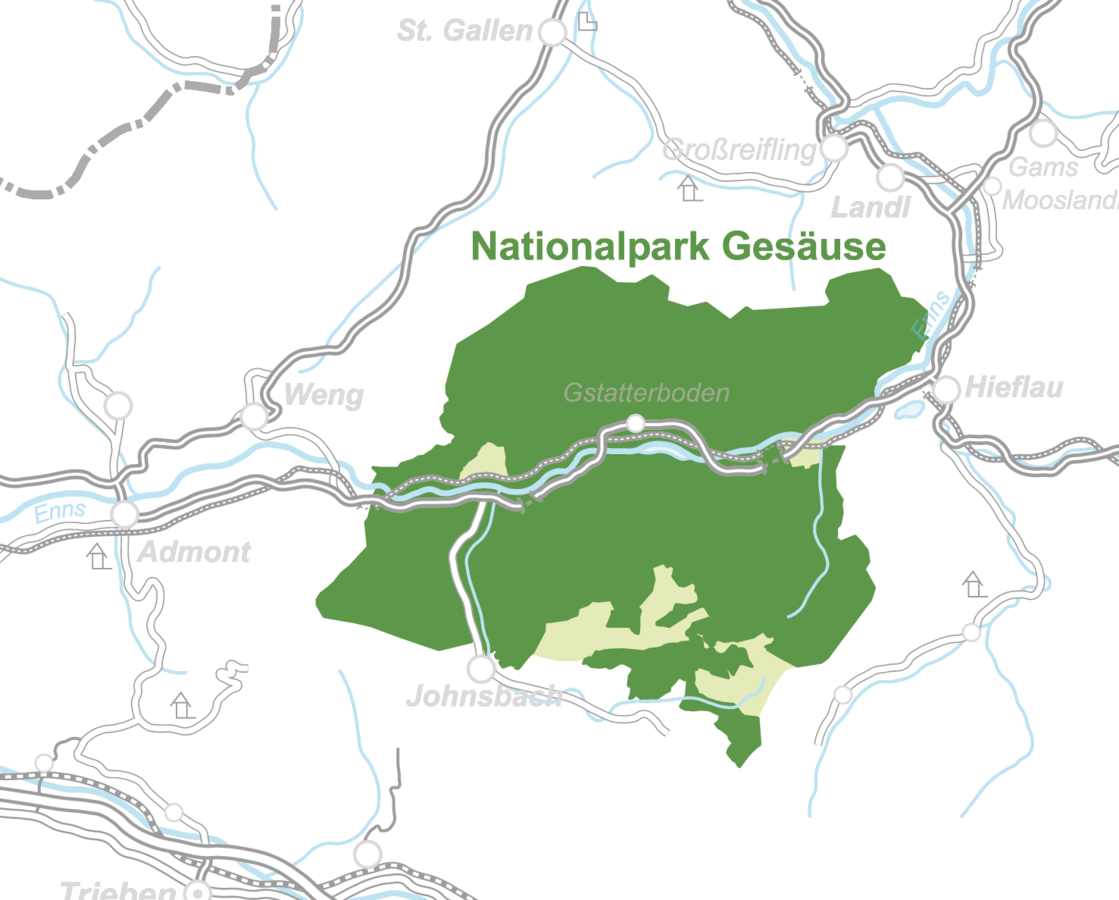
Between Admont and Hieflau, where the Enns River runs wild, the only Styrian national park - the Gesäuse - covers an area of about 12,000 hectares. We have summarized our absolute highlights around the national park for you here. What is still missing in this work of art is you.

Experience center Weidendom
In the middle of the national park there is a true oasis in the middle of the wilderness: the Willow Dome (Weidendom) has taken up residence there. The living construction in the national park is beautiful to look at and the offer in the adventure center has it all.


National park exhibition
A national park would only be half as good if it did not have visitor centers or museums. That is why there is also the National Park Pavilion in the heart of Gstatterboden, with the current exhibition about the Planspitze.


National park photo school
It is the untouched nature that attracts photographers from all over the world to the realms of the Gesäuse National Park. But what is the best way to get a capercaillie in front of the lens during courtship? This is where the Nationalpark Photo School can help.


Groups & schools
For students of all ages, the national park offers a varied program and for groups a varied excursion destination.


A paradise for flora and fauna
In the Gesäuse National Park, nature is left to its own devices; resources such as the forest are not exploited. As a result, a unique diversity of species survives here and continues to evolve freely.
There are currently around 200 endemic species – that is, animal and plant species that exist only in this microcosm. This makes the Gesäuse THE hotspot for endemic species in Austria! Join the national park rangers as you set off in search of the area’s flora and fauna. Pssst… if you’re really lucky, you might even spot a lynx on the prowl!


Gesäuse National Park
Quick & Short
12,000 hectares or 0.7% of the area of the province of Styria are national park and belong to the most beautiful things Styria has to offer. Along the untamed waters of the Enns River is one of the last breeding grounds for sandpipers. The wild forests are left to their own devices and endemic rarities such as the ornamental feathered carnation grow on the fearsome rock giants.
In the Gesäuse National Park, resources such as the forest are not exploited and nature is left to its own devices. Therefore, a special biodiversity survives here and develops freely. Such landscapes have become rare and are therefore particularly valuable.


A national park is where people and the wilderness meet.
Special experiences and insights in the Gesäuse National Park:

The Courtship of the Capercaillies I Gesäuse National Park | Herfried Marek

The Milky Way above the entrance to the Gesäuse | Haasmann

Johnsbach Footbridge over the River Enns I Gesäuse | Stefan Leitner

Youth at the top I Gesäuse National Park | Stefan Leitner

Ausblick vom Rauchbodenweg I Gesäuse | © TV Gesäuse | Thomas Sattler

Johnsbacher Gorge I Gesäuse National Park | © TV Gesäuse | Thomas Sattler
FAQ
Interesting facts about the Gesäuse National Park
Are you curious? Here you’ll find answers to the most frequently asked questions about the Gesäuse National Park!
No, the Gesäuse National Park is free of charge and open to everyone.
A visit to the Gesäuse National Park is impressive at any time of year – depending on what you’re looking for.
- Spring (April–June): Snowmelt, the mighty River Enns, the first blossoms, the ideal time for nature watching
- Summer (July–September): Peak season for hiking, mountaineering, ranger programmes & photography courses
- Autumn (October): Clear views, vibrant colours, quiet trails
- Winter (December–March): Tranquillity, winter walks & snowshoe tours in selected areas
The months of June to October are particularly well suited for classic hikes.
Unfortunately not, as the animals live freely in the wild within the national park. So you’ll need a bit of luck to spot one. Our rangers will explain how and when you’re most likely to see wildlife and will be happy to take you on a wildlife spotter’s tour.
The Gesäuse National Park is home to golden eagles, chamois, red deer, otters, capercaillies and grouse, bats, common sandpipers, dippers and grey wagtails, grayling, brown trout and bullhead, fire salamanders and Alpine newts, as well as lynx.
Everyone is welcome! A visit to the National Park is particularly suitable for:
- Families: nature trails, ranger programmes, hands-on nature experiences
- Sports enthusiasts: From hiking and mountaineering to cycling, from leisurely to challenging alpine routes
- Nature and knowledge seekers: Guided tours, exhibitions, research, courses
- People with reduced mobility: Accessible facilities around Admont and the Weidendom
Yes! There’s the National Park Pavilion in Gstatterboden, which has an exhibition and a café, as well as the Weidendom visitor centre near Johnsbach.
Yes, dogs are allowed in the Gesäuse National Park, but they must always be kept on a lead!
Wild camping is prohibited in the Gesäuse National Park. However, there is the Forstgarten campsite in Gstatterboden, which offers space for around 100 people on the banks of the Enns and boasts particularly idyllic views.
No, the Styrian Eisenwurzen Nature and Geopark is a separate protected area within the Gesäuse adventure region. You can find out more here: https://eisenwurzen.com/


