


Less light. More universe.
The Gesäuse is now a Dark Sky Reserve.
When the sun sets in the Gesäuse, the real spectacle begins:
The Milky Way, constellations, planets – all are visible to the naked eye. A spectacular show without a screen. Because: you are in Central Europe’s largest Nature Night Area. And that means: minimal light pollution, maximum wonder.
In 2026, 20 municipalities, 6 protected areas and a region five times the size of Vienna were designated a Dark Sky Reserve. This not only actively reduces light pollution but also preserves the natural night sky and habitat for people, animals and nature.
A holiday in the Gesäuse therefore means rediscovering the night as it was meant to be: an experience combining wilderness, tranquillity and fascinating glimpses into the universe.
Switch off your mobile. Switch on the sky.


5 stars? We’ve got millions!
Starry sky in the Gesäuse
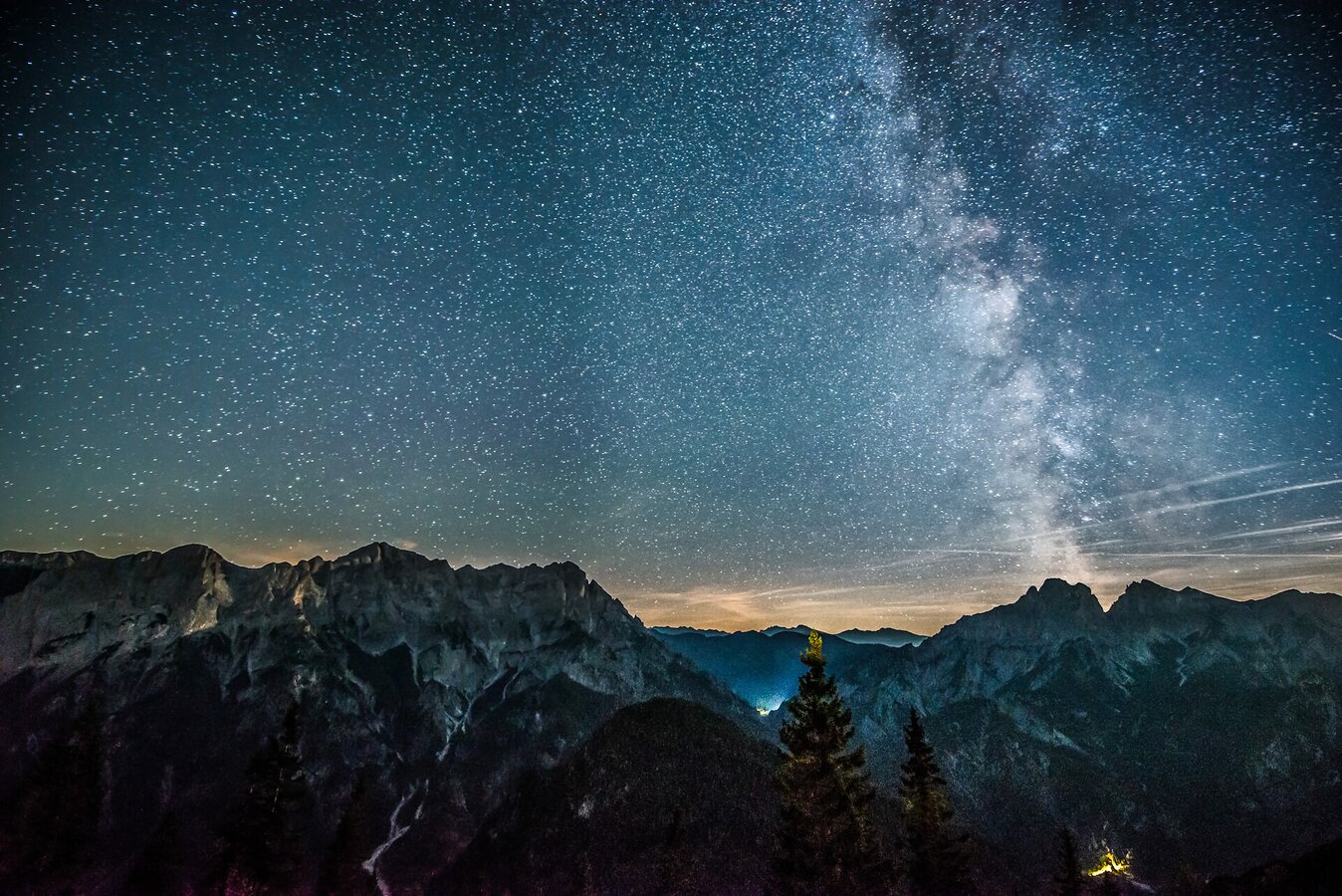
Impressive night sky in the Gesäuse | © Andreas Hollinger | Nationalpark Gesäuse
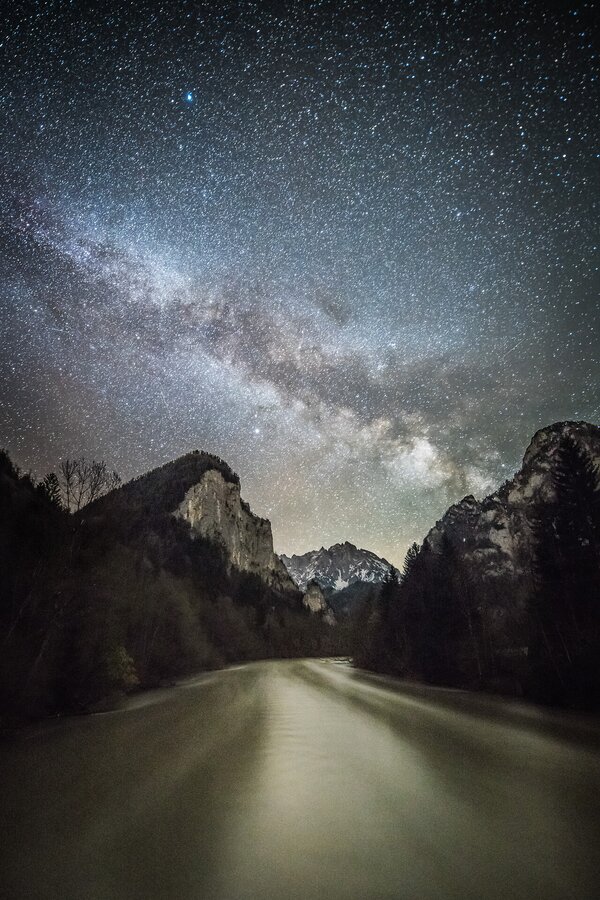
Gesäuse entrance at night I Steiermark | © Andreas Hollinger | Nationalpark Gesäuse

Night at the Hörantalm I Gesäuse I Steiermark | © Stefan Leitner | TV Gesäuse
FAQs
Are you curious? Here you’ll find answers to the most frequently asked questions about Nature Night and the starry sky in the Gesäuse!
The Gesäuse boasts the darkest night sky in Austria – and therefore the perfect conditions for starry nights! As a Dark Sky Reserve, the Gesäuse forms part of the largest nature night area in Central Europe, so artificial lighting is deliberately kept to a minimum here, making the starry sky particularly clear.
The Eisenwurzen nature night area covers 2,396 km². That is five times the size of Vienna! It is therefore the largest dark sky area in Central Europe and is certified as a Dark Sky Reserve.
The Gesäuse has always been regarded as the darkest place in Austria and was known as a hotspot for stargazing and astrophotography. It therefore made perfect sense to formalise these qualities. Since 2025, it has been part of Central Europe’s largest nature night area, the Eisenwurzen nature night area, as a Dark Sky Reserve.
You can see the starry sky clearly from anywhere here on clear nights – a few particularly good spots for stargazing are:
- Buchauersattel: Mountain views and night-time photography
- National park centre willow dome: Views of the sky and the Hochtor mountain group
- Forstgarten Campsite: Sleeping under the stars
- Kölblwirt Johnsbach: Overnight stay in the "Stars Suite"
- Buchsteinhaus & Ennstalerhütte: Mountain huts right under the starry sky
- Gallenstein Castle Ruins: Viewpoint and guided tours
- Brunnsee and Brunnalm Wildalpen: Stargazing by the lake
- Lackneralm Palfau: Nature Friends’ hut, viewpoint and overnight accommodation
So grab your picnic blanket and on your marks, get set, marvel!
Artificial light destroys habitats! Light pollution affects humans, animals and plants – they all need darkness at night:
- For us humans: Artificial light inhibits the production of melatonin – which disrupts sleep and our circadian rhythm. Healthy and restful sleep means sleeping in the dark!
- For animals: Nocturnal animals such as bats, owls and amphibians are disturbed or even driven away, with long-term consequences for entire ecosystems. Light sources attract insects – which become exhausted or burnt. This has consequences for the animals that feed on them.
- For plants: Artificial light disrupts the natural rhythm; trees, for example, shed their leaves later and are more susceptible to frost. Night-time pollination is also disrupted because insects are absent.
- For the world: Less light means lower energy consumption and CO₂ emissions – a contribution to climate protection. And: Light pollution makes the starry sky disappear.
Der dunkelste Ort in Österreich und sogar im gesamten Alpenraum ist laut Messungen hier bei uns im Gesäuse, in Johnsbach. Aufgrund der abgeschiedenen Lage und des bewussten Umgangs mit Licht ist der Nachthimmel hier am dunkelsten in ganz Österreich – und der Sternenhimmel daraufhin am allerbesten sichtbar.
There are nine active monitoring stations throughout the Dark Sky Reserve, which continuously record sky brightness. Data collection is carried out in accordance with strict criteria in collaboration with the University of Vienna and the E.C.O. Institute. All lights are recorded, measured and documented photographically to serve as the basis for the application to DarkSky International.
You can see the Milky Way in the Gesäuse whenever the sky is clear – ideally from March to October. The best conditions are on moonless nights, such as during a new moon. The view is particularly impressive in late summer, around September. The galactic centre of the Milky Way is visible in the early hours of the morning in spring, throughout the night in summer, and in the early evening in autumn.
Yes, there are regular guided tours, workshops and night-time walks with fascinating explanations of the night sky.
In the Gesäuse, you are free to roam – but in the Gesäuse National Park, you must stay on the marked paths and keep as quiet as possible to allow the animals and plants their well-deserved night’s rest. You’ll find the best conditions at our stargazing spots.
Yes, there’s a whole range of experiences on offer: stargazing walks, film nights under the stars, sleeping under the stars, night-time photography workshops, dinner and stargazing, and many more opportunities to gaze at the stars.
Yes, the starry sky is particularly clear throughout the Gesäuse National Park and its surroundings, as this is a protected Nature Night Area – the Dark Sky Reserve. But the other villages in the Gesäuse are also ideal for stargazing. Our mountain huts, for example, are always a good choice!


